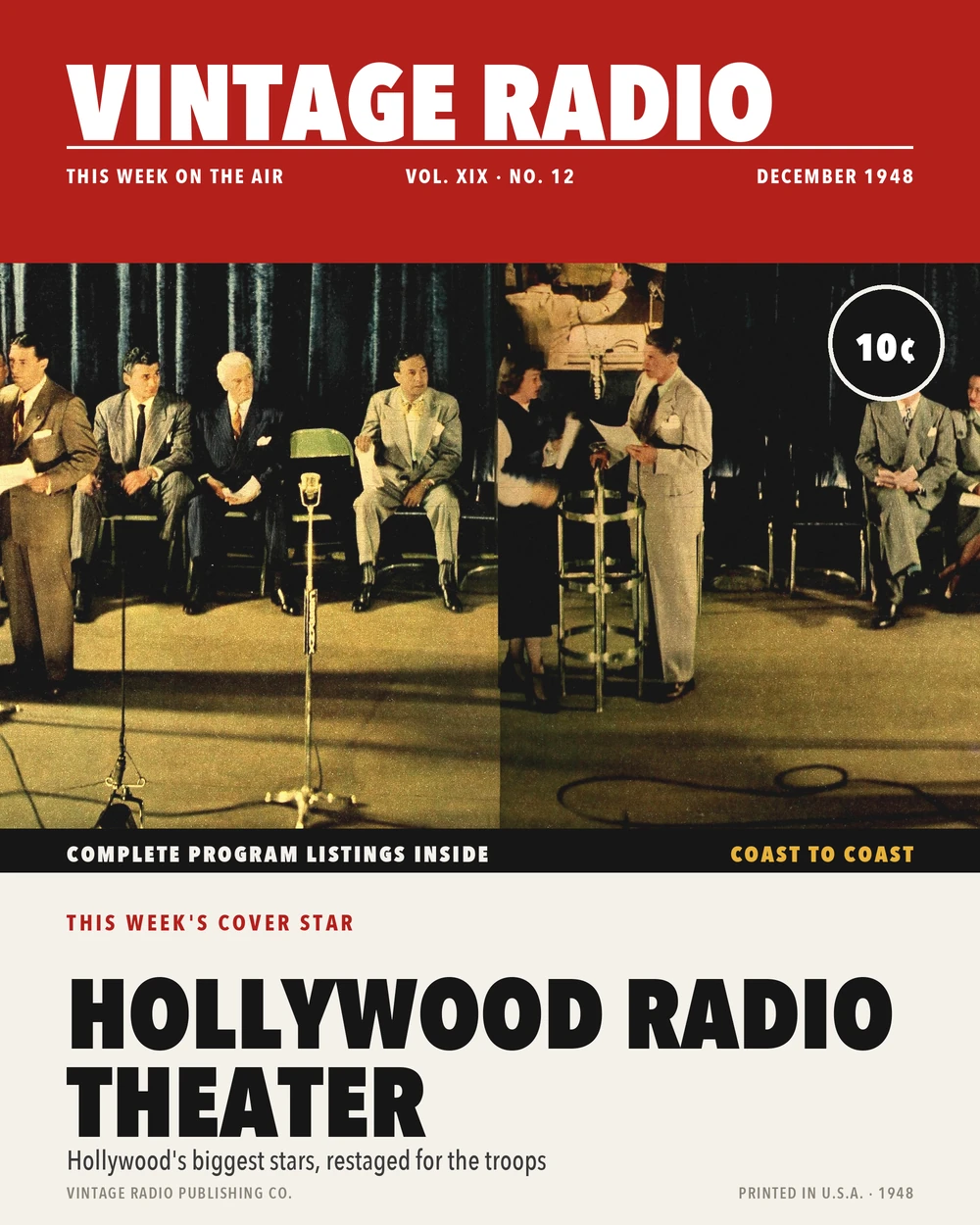
Hollywood Radio Theater
What It Actually Was
Hollywood Radio Theater is a name that turns up in old-time radio catalogs under circumstances worth explaining. The title was not, as some early references suggested, an independent drama series launched in 1938 by a production company of the same name. Multiple OTR research sources consistently identify Hollywood Radio Theater as the Armed Forces Radio Service re-titling of Lux Radio Theatre — the practice the AFRS used whenever it distributed commercial network programs to troops overseas. The sponsor's name came out of the title, the Lux soap advertisements were replaced by public service announcements aimed at servicemen and women, and the program went out under the Hollywood Radio Theater banner. Those AFRS airings circulated in the early 1950s. No reliable source corroborates either a 1938 premiere date or a production company called the Hollywood Radio Production Company.
The underlying material — the Lux Radio Theatre broadcasts that became Hollywood Radio Theater for AFRS distribution — is a different story altogether. Lux Radio Theatre ran on CBS from October 14, 1934 until June 7, 1955, and has been described as indisputably the biggest, most important, and most expensive drama anthology program on radio. The AFRS version carried that same content to audiences who had no access to commercial American broadcasting.
The Source Material: Lux Radio Theatre
Lux Radio Theatre was sponsored by Lever Brothers and built around one central idea: bring Hollywood's biggest films and stars to a radio audience. Original stars reprised their own film roles whenever possible, receiving $5,000 per appearance — a significant sum that reflected how seriously both the network and the studio world took the enterprise. Productions were rehearsed for a full week before broadcast, and the show went out live before a studio audience. That level of preparation gave the performances a polish that set the program apart from the faster-turnaround radio work of the era.
The roster of performers who appeared on Lux — and by extension on the AFRS Hollywood Radio Theater editions — included major figures like James Cagney, Bette Davis, and Cary Grant. The format leaned on film adaptations, though original material appeared as well. What held it together was a consistent emphasis on dramatic tension and character, the same qualities that made the source films successful in theaters. For the early 1950s AFRS airings, Don Wilson served as host.
The Name's Other Life
The Hollywood Radio Theater name has a second, separate history. In 1973–74, it was used as an alternate title for The Zero Hour, a drama anthology series hosted by Rod Serling that debuted in syndication on September 3, 1973, and was picked up by the Mutual Broadcasting System that December. The Zero Hour version was produced by Don Hills for StudioHouse. The two programs share a title and the anthology drama format, but they are otherwise unrelated — different eras, different production teams, different creative contexts.
What Survives
The catalog here includes two episodes that traveled under the Hollywood Radio Theater name: "Out Of The Great Gods Heart" and "Tomorrow Will Come." The broader preserved archive runs deeper — 27 episodes are documented in circulation, including "Bullets Or Ballets" dated April 16, 1939 and "The Tang Of Autumn" dated July 22, 1944. Those dates likely correspond to original Lux Radio Theatre broadcasts that the AFRS later re-edited and redistributed under the Hollywood Radio Theater banner. The span of surviving material reflects both the longevity of the underlying Lux series and the reach of AFRS distribution, which was established in the early months of American involvement in World War II specifically to bring entertainment to troops stationed far from home.
Hollywood Radio Theater sits within a recognizable tradition of film-adaptation anthology programs — among them Academy Award Theater, Hollywood Star Time, Cresta Blanca Hollywood Players, General Electric Theater, and Skippy Hollywood Theater — that treated radio as a medium capable of carrying serious dramatic work to audiences who had no other access to the performances.